Wednesday, August 22, 2007
Downtown Portland Perspectives, Part 1
I greatly enjoyed spending a few days wandering around Downtown Portland, Oregon taking photos and observing the city through my urban planning-colored glasses. Portland, as many of you probably know, is hailed as being exceptionally progressive from a planning perspective, and I wouldn't disagree. There are certainly plenty of things Denver can learn from Portland to help make Downtown Denver even better. I will comment on a few of those, but I'm going to break my observations up into a series of posts because I don't have time to record them here all in one sitting.
To begin, one of the first things I noticed that gives Downtown Portland a manageable, intimate pedestrian environment goes back to the original platting of the downtown area over a century ago: the width of the street right-of-way. From building face to building face, the span of the street right-of-way on most of the Downtown Portland blocks is quite narrow, particularly by Western U.S. standards. Here, take a look:
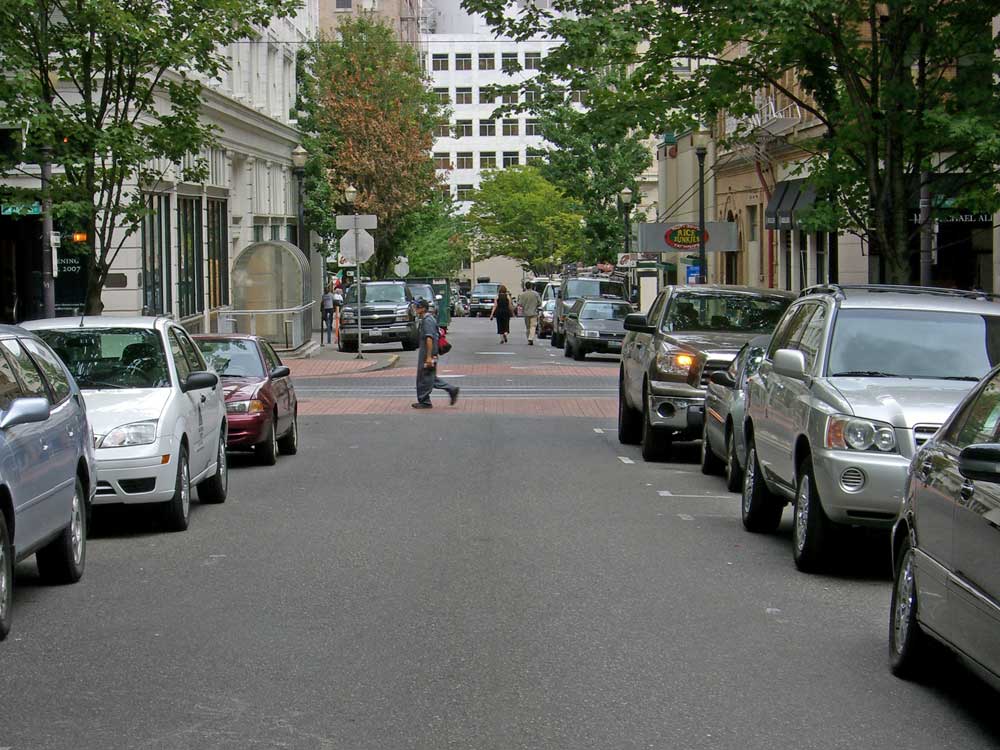
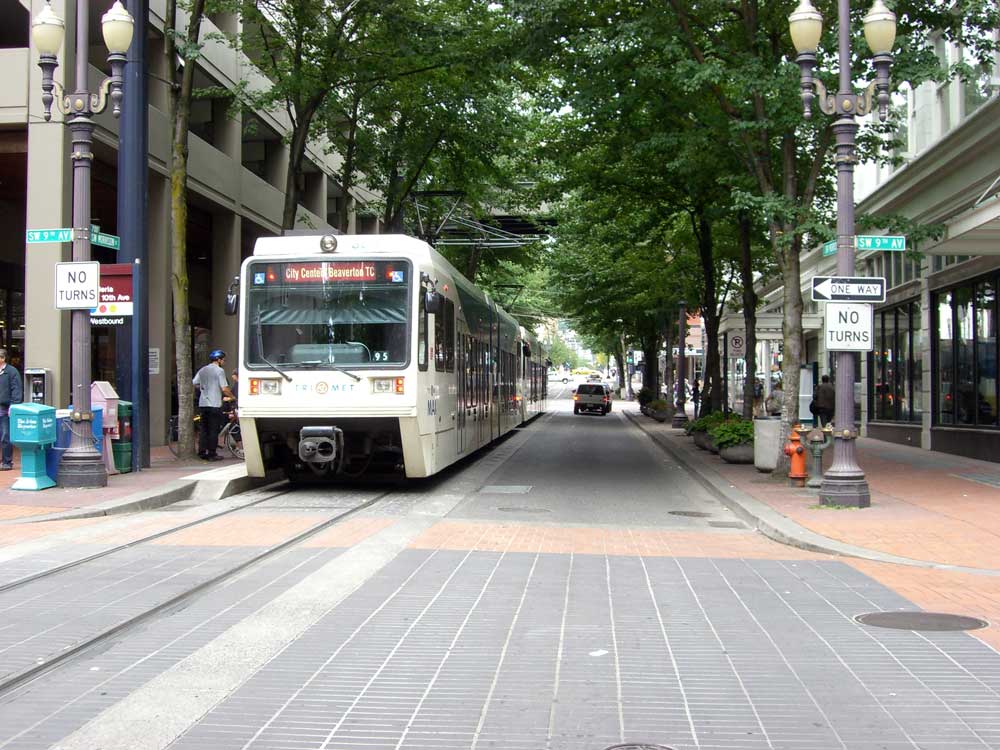
A relatively wide street for Downtown Portland has a right-of-way distance that would be considered average to most local streets in Downtown Denver. Here's a Downtown Portland street with three (gasp!) through lanes:
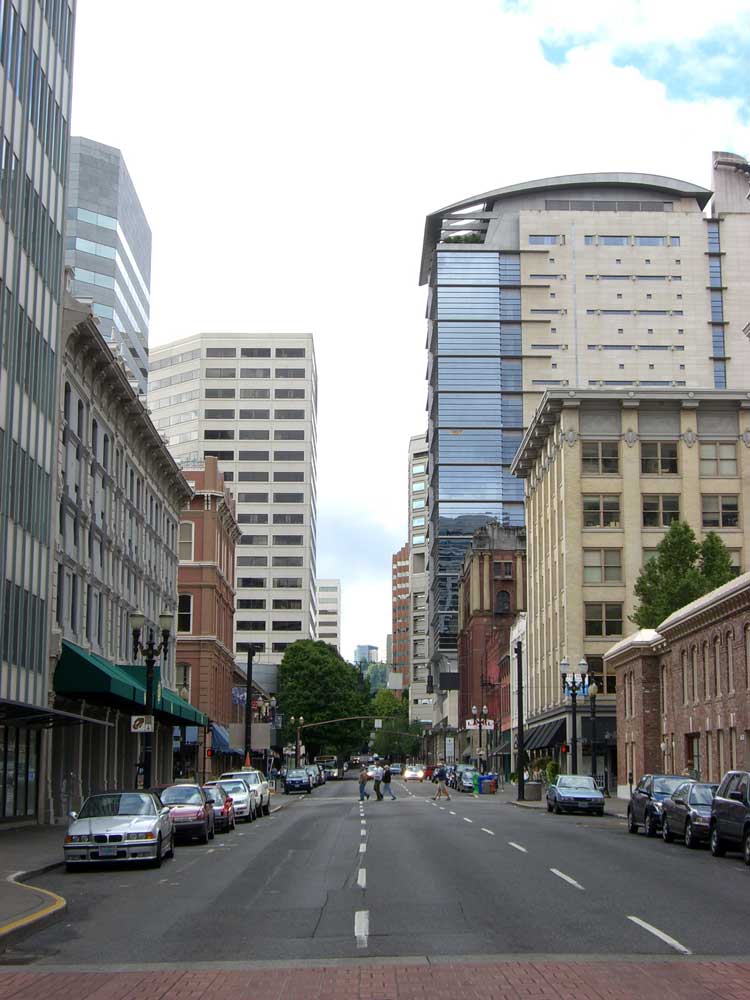
Now, there's nothing we can do now about the width of the right-of-way of Downtown Denver streets. But, we can do something about what we do within that right-of-way. Clearly, there are many streets in Downtown Denver that simply do not need as many vehicle lanes as there are today. In fact, one of the greatest battles that we must yet win before we can achieve true urban greatness in central Denver is with the city's traffic engineering department. Most traffic engineers (and certainly not just in Denver) over the last fifty years have operated under a philosophy that their number one priority is to maximize the volume and speed of motor vehicles along the public right-of-way. This has left us with a Downtown Denver where even "local" Downtown streets have three or four through lanes, a parking lane or two, usually no bike lanes, and narrow sidewalks. At least in the central Denver area, we have to turn that philosophy on its head. The new Downtown Area Plan's call for Downtown Denver to be a "Pedestrian Priority Zone" will mean little unless we can achieve a fundamental change in how we perceive and, consequently, use the public right-of-way. I know many of the folks at Public Works are completely on-board in this thinking but, unfortunately, there are still those in high places who are horrified by the concept of removing traffic lanes on Downtown streets. That is a battle that we must win before we can truly achieve an exceptional Downtown pedestrian environment.
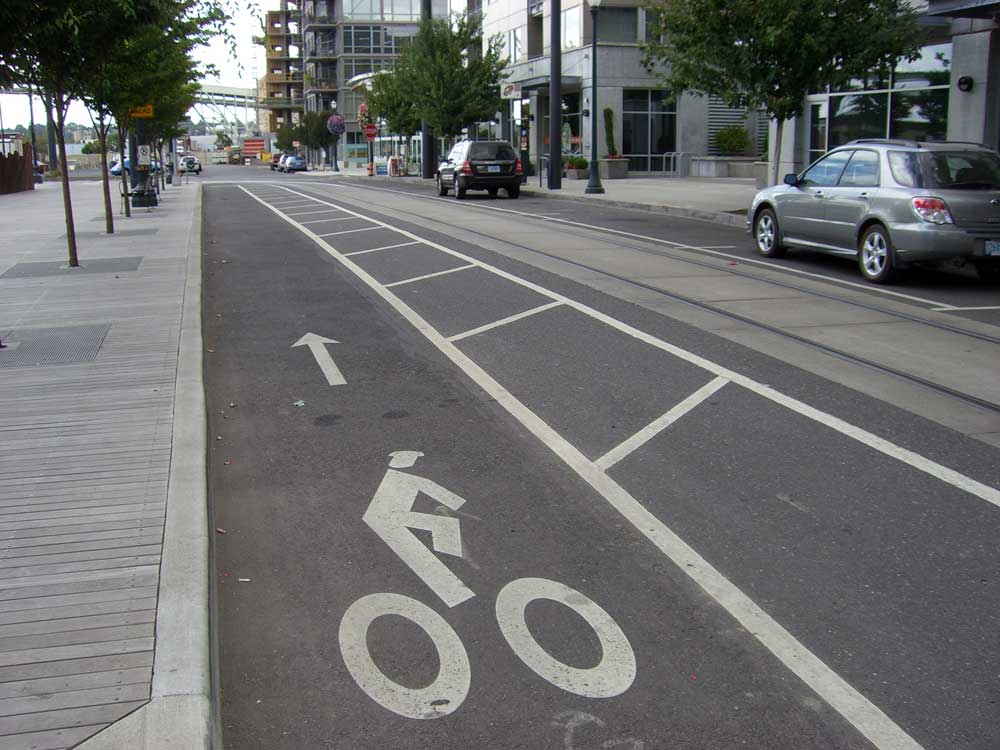
Here are a few more street shots from Downtown Portland:


To begin, one of the first things I noticed that gives Downtown Portland a manageable, intimate pedestrian environment goes back to the original platting of the downtown area over a century ago: the width of the street right-of-way. From building face to building face, the span of the street right-of-way on most of the Downtown Portland blocks is quite narrow, particularly by Western U.S. standards. Here, take a look:

A relatively wide street for Downtown Portland has a right-of-way distance that would be considered average to most local streets in Downtown Denver. Here's a Downtown Portland street with three (gasp!) through lanes:

Now, there's nothing we can do now about the width of the right-of-way of Downtown Denver streets. But, we can do something about what we do within that right-of-way. Clearly, there are many streets in Downtown Denver that simply do not need as many vehicle lanes as there are today. In fact, one of the greatest battles that we must yet win before we can achieve true urban greatness in central Denver is with the city's traffic engineering department. Most traffic engineers (and certainly not just in Denver) over the last fifty years have operated under a philosophy that their number one priority is to maximize the volume and speed of motor vehicles along the public right-of-way. This has left us with a Downtown Denver where even "local" Downtown streets have three or four through lanes, a parking lane or two, usually no bike lanes, and narrow sidewalks. At least in the central Denver area, we have to turn that philosophy on its head. The new Downtown Area Plan's call for Downtown Denver to be a "Pedestrian Priority Zone" will mean little unless we can achieve a fundamental change in how we perceive and, consequently, use the public right-of-way. I know many of the folks at Public Works are completely on-board in this thinking but, unfortunately, there are still those in high places who are horrified by the concept of removing traffic lanes on Downtown streets. That is a battle that we must win before we can truly achieve an exceptional Downtown pedestrian environment.
Here are a few more street shots from Downtown Portland:

Comments:
Links to this post:
<< Home
Nice job K-k-ken!
Wow! Bike paths, healthy trees, brick(!), street lamps for people rather than spot lights for cars and shade.
You summed it up very well: our ped experience needs some work.
Wow! Bike paths, healthy trees, brick(!), street lamps for people rather than spot lights for cars and shade.
You summed it up very well: our ped experience needs some work.
If our blocks are bigger, that means we have a lower density of roads in our downtown. Doesn't that require us to have more lanes on each road to convey the same traffic as Portland?
I definitely agree that Denver needs to close one traffic lane on each road to expand the size of the sidewalks. As important as sidewalks are medians with trees, or other forms of greenery running through the heart of Downtown.
I think trees make a huge impact on the look and feel of an urban area, but there are some hurdles to cross. Very few trees can survive the hot, polluted environment of an asphault jungle. On top of that, few people realize that tree roots need oxygen to survive, so even if you pipe water under the concrete, the the lack of oxygen eliminates the option of all but a few tree species.
The #1 species of tree found in downown Denver is honeylocust, which is very adaptable to urban areas. But in the poor environment city streets provide, they tend to start to yellow and lose leaves in mid-August, which means they're in poor health. And since there are so many trees of the same species at close proximity, disease epidemics or dry spells could wipe out the entire population - especially when they're all already stressed.
Portland is really green, but part of that is because there is a lot of water there; they about twice as much rain as we have in Denver, plus a lot of moisture available to plants through dew and condensation, and the cooler weather means that the rain Portland gets stays with trees longer. Mild winters also give trees a longer growing season to add leaves and city arborists have a wider selection of trees to choose from, since cold-hardyness isn't as important.
Greening up the urban core of Denver is going to require some strategic changes to make way for the health of trees (perhaps open soil and gardens in some areas instead of concrete), but I think it's absolutely vital to the success of the downtown area. Trees significantly reduce particulate pollution and carcinogens from the air, eliminate the scorching heat-island effect of urban summers, and improve land value and asthetics. But part of that requires plant breeders to come up with better hybrids that can live in the adverse environment, and another part requires residents to really appreciate and ask for more trees.
I think trees make a huge impact on the look and feel of an urban area, but there are some hurdles to cross. Very few trees can survive the hot, polluted environment of an asphault jungle. On top of that, few people realize that tree roots need oxygen to survive, so even if you pipe water under the concrete, the the lack of oxygen eliminates the option of all but a few tree species.
The #1 species of tree found in downown Denver is honeylocust, which is very adaptable to urban areas. But in the poor environment city streets provide, they tend to start to yellow and lose leaves in mid-August, which means they're in poor health. And since there are so many trees of the same species at close proximity, disease epidemics or dry spells could wipe out the entire population - especially when they're all already stressed.
Portland is really green, but part of that is because there is a lot of water there; they about twice as much rain as we have in Denver, plus a lot of moisture available to plants through dew and condensation, and the cooler weather means that the rain Portland gets stays with trees longer. Mild winters also give trees a longer growing season to add leaves and city arborists have a wider selection of trees to choose from, since cold-hardyness isn't as important.
Greening up the urban core of Denver is going to require some strategic changes to make way for the health of trees (perhaps open soil and gardens in some areas instead of concrete), but I think it's absolutely vital to the success of the downtown area. Trees significantly reduce particulate pollution and carcinogens from the air, eliminate the scorching heat-island effect of urban summers, and improve land value and asthetics. But part of that requires plant breeders to come up with better hybrids that can live in the adverse environment, and another part requires residents to really appreciate and ask for more trees.
I had heard that the typical wide western avenue was in order to facilitate snow removal.
Frankly, I'd like to see some narrrower streets - some of Denver's are hard to cross in time.
I would love to have some more bikelanes and wider sidewalks. It angers me when one has to get off the sidewalk to allow a couple to pass, that is unacceptable! Trees would be nice...but thanks to Matt, it doesn't look too promising... I just want Denver to be walkable.
I agree completely with Matt. Part of the allure of the 16th Street mall are the 25 year old trees that line the entire street. It is nice to have a respite from the endless hot days in summer by having some shade. Let's hope when 14th street gets a face lift, quality landscaping is a high priority.
In Salt Lake City, the rumor is that the streets are as wide as they are (in downtown) so that a wagon pulled by a team of horses could do a U-turn within the width of the street. Also, I've heard that in some western towns, at least those developed after trains came into being, driving cattle herds through town created the need for wide streets. The cattle had to be able to reach the railroad cattle cars for transport to the stock yards in other cities.
I don't think snow removal had much to do with it, or there'd be really wide streets in my Michigan hometown, and there aren't.
I was recently in St Louis and found their downtown streets very very attractive with landscaped medians, flowers, and trees. I understand what Matt has said about trees and I agree. If not trees, then bushes or flowering foliage with underground drip systems would be nice.
But we're basically repeating what we already know. The ped experience needs incredible help..but a lot of that can't change without $$$ and comittment!
I'm not saying it's impossible to grow healthy trees downtown, I'm just saying why it's so difficult. I think if people really rallied for them, it could happen.
Post a Comment
Links to this post:
<< Home